PERTURBATIVE QFT FOR GRAVITATIONAL WAVES
PERTURBATIVE QFT FOR GRAVITATIONAL WAVES
Nonlocal-in-time dynamics @ 5PM
Gregor Kälin

Based on work with C. Dlapa, Z. Liu & R. Porto
Amplitudes, Strong-Field Gravity and Resummation 14.04.2026 Nordita Stockholm
PERTURBATIVE QFT FOR GRAVITATIONAL WAVES
PERTURBATIVE QFT FOR GRAVITATIONAL WAVES
Nonlocal-in-time dynamics @ 5PM
Gregor Kälin
Based on work with C. Dlapa, Z. Liu & R. Porto
Amplitudes, Strong-Field Gravity and Resummation 14.04.2026 Nordita Stockholm
Overview
- Motivation: Boundary-To-Bound
- Worldline EFT Framework
- Nonlocal-In-Time Conservative Dynamics @ 5PM & 10SF
- Integration Technology
- Conclusions & Outlook
High-Precision Era
Taiji (2033-2035) | LISA (2035) | Cosmic Explorer (2035 - 2040) | Einstein Telescope (2035) | TianQin (2035)
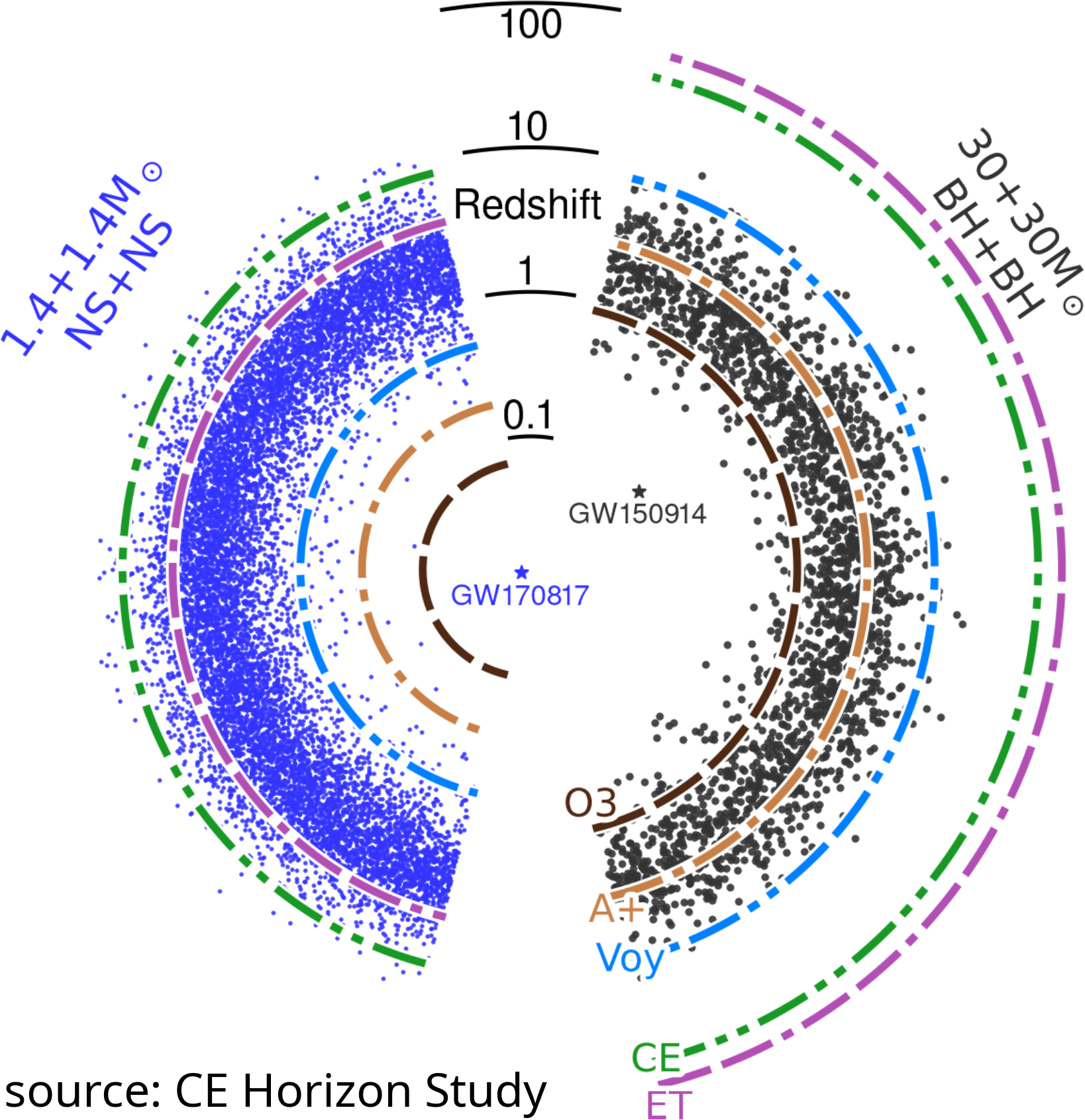
From detection to parameter estimation: Need high-Precision Analytical data!
Semi-Analytical Waveform Models
[EOB: Buonanno, Damour 1998][SEOBNRv5: Khalil et. al. 2023, Pompili et. al. 2023][LEOB-PM: 2503.05487 Damour et. al.]
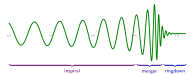

Best of all worlds: Fast & accurate
Boundary2Bound
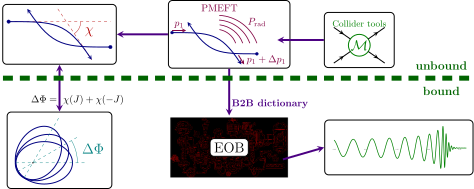
- Dictionary between bound and unbound observables
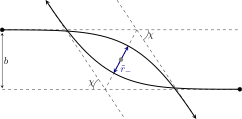
- Analytic continuation: One bound orbit = two scattering events
- E.g. pariastron advance \(\leftrightarrow\) scattering angle: \(\Delta\Phi = \chi(J) + \chi(-J)\)
- Backbone of Perturbative QFT For Gravitational Waves program
- Enables use of collider physics tools & data for GW physics
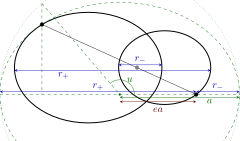
Analytic continuation: intuitive understanding
[van de Meent, unpublished (talk at "From Amplitudes to Gravitational Waves"), 2023]
- Bound & unbound are in same class of geodesic solutions
- Boundary \(\rightarrow\) bound data: Start with data for \(r>0\); complete with data for \(r<0\) obtained via:
- Option A (for explicit trajectory/geodesic): Mino Carter-time \(\lambda \rightarrow -\lambda\)
- Option B: eccentricity \(e \rightarrow -e\)
- Option C: universe \(\rightarrow\) anti-universe, \(G M\rightarrow -GM\)
- Option D: angular momentum \(J \rightarrow -J\); \(r_- = r_\textrm{min}(J)\), \(r_+ = r_\textrm{min}(-J)\)
- Analytically continue to bound kinematical regime (\( \cE > M \rightarrow \cE < M \))
$$\Delta \Phi + 2\pi = 2J \int_{r_-}^{r_+} \frac{\dd r}{r^2\sqrt{\bp^2(r,E)-J^2/r^2}}
= 2J \int_{r_\textrm{min}(J)}^{\infty} \frac{\dd r}{r^2\sqrt{\bp^2(r,E)-J^2/r^2}}
-2J \int_{r_\textrm{min}(-J)}^{\infty} \frac{\dd r}{r^2\sqrt{\bp^2(r,E)-J^2/r^2}}
= \chi(J) + \chi(-J) + 2\pi $$
Radiation, Spin & Nonlocal-in-time dynamics
Analytical continuation of radiative observables, e.g. the energy and angular momentum loss
$$\begin{align}
\Delta E_\textrm{ell}(J,E) &= \Delta E_\textrm{hyp}(J,E)-\Delta E_\textrm{hyp}(-J,E)\\
\Delta J_\textrm{ell}(J,E) &= \Delta J_\textrm{hyp}(J,E)+\Delta J_\textrm{hyp}(-J,E)\\
\end{align}$$
$$\Delta\Phi(J,E) = \chi(J,E) + \chi(-J,E)$$
for \(J\) the total angular momentum (spin + orbit).
Problem: Nonlocal-in-time dynamics; more later!
Different approaches
- Scattering amplitudes & KMOC / Eikonal Approach
- Hamiltonian from 2-2 scattering amplitudes [1801.02489 Cheung, Rothstein, Solon][1901.04424 Bern et al.]
- Radiation from 2-2 scattering amplitudes & cuts [1811.10950 KMOC]
- Eikonal from 2-2 scattering amplitudes [2104.03256 Di Vecchia, Heissenberg, Russo, Veneziano]
-
Worldline/Post-Minkowskian Effective Field Theory (WLEFT/PMEFT)
- Conserved (classical) observables in a WL theory with bulk gravity [2006.01184 w/ Porto]
- Radiative (classical) observables using in-in formalism [2207.00580 w/ Neef, Porto]
- Local vs. nonlocal split [2403.04853 w/ Dlapa, Liu, Porto]
- Worldline Quantum Field Theory (WQFT)
- Conserved (classical) observables in a WL theory with bulk gravity [2010.02865 Mogull, Plefka, Steinhoff]
- Radiative (classical) observables using in-in formalism [2207.00569 Jakobsen et al.]
WorldlineEffectiveFieldTheory
[2006.01184, 2207.00580: GK, Porto + Neef]
- World-line description of massive compact objects coupled to bulk gravitational field
- EFT methodology:
- Full action \(\rightarrow\) Effective action \(\rightarrow\) Scattering observables \(\overset{\text{B2B}}{\rightarrow}\) Bound observables \(\rightarrow\) Waveform
- Complete & generic
- conservative motion
- radiation
- spin
- finite size
- \(n\)-body
- modifications of GR
- High-energy physics toolbox
- Feynman diagrams and rules\(\rightarrow\) integrand
- Feynman integrals
- Integral reduction
- Method of differential equations
- Method of regions
- Numeric integration
- A complete, systematic, and efficient computational framework
Worldline Model & Setup
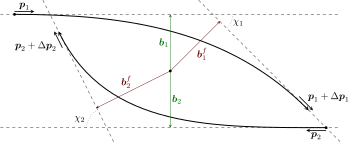
Model the compact bodies by worldlines \(x_a^\mu(\tau)\) coupled to GR. $$\begin{align} S_{\rm EH} &= -2\Mp^2 \int \dd^4x \sqrt{-g} \, R[g] + (\textrm{mod. of GR})\\ S_{\rm pp} &= -\sum_a \frac{m_a}{2} \int \dd\tau_a\, g_{\mu\nu}(x_{a}(\tau_a)) \dot{x}_{a}^\mu(\tau_a) \dot{x}_{a}^\nu (\tau_a)+(\textrm{spin, tidal,...})\\ \end{align}$$
Kinematical setup:
Computational procedure: Summary
- Classically integrate out gravitational field: Feynman diagrams/rules \(\Rightarrow\) e.o.m.
- In-in formalism: we compute expectation values, not S-Matrix elements.
$$ \left.\frac{\delta\mathcal{S}_\textrm{eff}[x_+,x_-]}{\delta x_-^\alpha}\right|_{\substack{x_-\to 0\\x_+\to x}}^\textrm{3PM} = $$
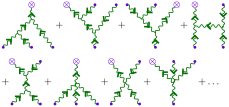
- Causal propagators (retarded/advanced) $$\begin{align}\Delta_\mathrm{ret}(p) &= \frac{1}{(p_0^2+i0) - \bp^2}\,, & \Delta_\mathrm{adv}(p) &= \frac{1}{(p_0^2-i0) - \bp^2}\end{align}$$
- In-in formalism: we compute expectation values, not S-Matrix elements.
- Solve e.o.m. for the worldlines iteratively & plug into observable
- Linear propagators: \(\frac{1}{\ell\cdot u_a \pm i0}\)
- Compute Feynman integrals (e.g. for \(\Delta p\) or \(P_\textrm{rad}\))
$$
\int \dd^Dq\frac{\delta(q\cdot u_1)\delta(q\cdot u_2)e^{i b\cdot q}}{(q^2)^m}
\underbrace{\int \dd^D\ell_1\cdots\dd^D\ell_L\frac{\delta(\ell_1\cdot u_{a_1})\cdots\delta(\ell_L\cdot u_{a_L})}{(\ell_1\cdot u_{b_1}\pm i0)^{i_1}\cdots(\ell_L\cdot u_{b_L}\pm i0)^{i_L}(\textrm{sq. props})}}_{\textrm{Cut Feynman integrals with linear and square propagators}}
$$
- Single scale \(\gamma = u_1\cdot u_2\); \(u_1^2 = u_2^2 = 1\)
- One delta function (cut linear propagator) per loop
- Outer Fourier transform is simple
Nonlocal-In-Time Conservative Dynamics
- Effective two-body Hamiltonian $$\cH = \cH_\mathrm{loc} + \mathrm{Pf} \int_{-\infty}^t \frac{\dd \tilde{t}}{|t-\tilde{t}|}\mathcal{F}(r(t),r(\tilde{t}))\,,$$ depends on past-time trajectory!
- B2B fails for nonlocal-in-ime contributions @ circular orbits
- What now?
Universality
Nonlocal-in-time tail(!) contributions to radial action have universal form $$\cS_r^{\textrm{nloc}} = -\frac{GE}{2\pi}\int_\omega \frac{\dd E}{\dd \omega} \log\left(\frac{4\omega^2}{\mu^2}e^{2\gamma_\textrm{E}}\right)$$Integrand construction
We know how to construct integrand for
$$\Delta E = u_\textrm{com}\cdot P_\textrm{rad} = \int_\omega \frac{\dd E}{\dd \omega} = \int_\omega\int\dots\,,$$
with
- \(\omega = k\cdot u_\textrm{com}\); \(u_\textrm{com}=(m_1 u_1 + m_2 u_2)/E\)
- \(k\) the on-shell momentum of the 1rad region
- \(u_\textrm{com}=\frac{m_1 u_1+m_2 u_2}{E}\).
Insert log and compute: Split PM scattering angle into loc & nloc Loc: B2B; nloc bound from PN
Nonlocal integration
Trick: \(\log(k\cdot u_\textrm{com}) = \left. (k\cdot u_\textrm{com})^{2\tilde\epsilon}\right|_{\tilde\epsilon^1}\)
$$
\int \dd^Dq\frac{\delta(q\cdot u_1)\delta(q\cdot u_2)e^{i b\cdot q}}{(q^2)^m}
\int \dd^D\ell_1\cdots\dd^D\ell_{L-1}\dd^Dk\frac{\delta(\ell_1\cdot u_{a_1})\cdots\delta(\ell_{L-1}\cdot u_{a_{L-1}})\delta(k\cdot u_{a_L})(k\cdot u_\textrm{com})^{2\tilde\epsilon}}{(\ell_1\cdot u_{b_1}\pm i0)^{i_1}\cdots(\ell_{L-1}\cdot u_{b_{L-1}}\pm i0)^{i_{L-1}}(k\cdot u_{b_L}\pm i0)^{i_L}(\textrm{sq. props})}
$$
- New scale: mass ratio \(q=m_2/m_1\): Breaks mass polynomiality!
- IBPs with non-integer exponents: implemented in Finite Flow & SpIRed
- Minor technical difficulty: New linear propagator is not linearly independent!
- Differential equations: \(\epsilon/\tilde{\epsilon}\)-form
Result @ 4PM
$$\partial_J \cS_r \propto \frac{\chi}{2} = \sum_{n=1}^\infty \left(\chi_b^{(n)\textrm{loc}} + \chi_b^{(n)\textrm{nloc}} + \chi_b^{(n)\!\log}\log\frac{\mu b}{\Gamma}\right)\left(\frac{GM}{b}\right)^n$$
- Full answer contains iterated elliptic integrals, with, e.g., an integral kernel of the form $$\frac{\textrm{K}(-q x)\textrm{K}(1+q/x)-\textrm{K}(-q/x)\textrm{K}(1+qx)}{\pi}$$
- Completed by MPLs up to weight 2
- These are ALL nonlocal-in-time contributions at 4PM
- For all practical purposes: 30SF expanded version
Self-force expansion
Expand additionally in \(q=m_2/m_1\) (or by symmetrization in \(\nu=m_1 m_2/M^2 \leq 1/4\))
$$\log\left[(k\cdot u_\textrm{com})^2\right] = \log\left[(k\cdot u_1)^2\right] - 2 \sum_{n=1}^\infty \frac{(-1)^n}{n} \left(\frac{k\cdot u_2}{k\cdot u_1}\right)^n q^n + \textrm{const}$$
Same integral family as \(\Delta E\) @ 4PM with high propagator powers:
Symbolic IBP reduction becomes very powerful!
Symbolic IBP reduction becomes very powerful!
Result @ 4&5PM
$$\begin{align}
\frac{\chi_{b(\textrm{nloc})}^{(4)(30SF)}}{\pi\Gamma\nu} &= \sum_{i=1}^{12} h_i(x,\nu) \cal{G}_i(x)\\
\frac{\chi_{b(\textrm{nloc})}^{(5)(10SF)}}{\Gamma\nu} &= \sum_{i=1}^{26} h_i(x,\nu) \cal{G}_i(x) \qquad \mathrm{\large\bf{(new)}}\end{align}$$
with coefficients
$$h_i(x,\nu) = \sqrt{1-4\nu}h_i^{(\Delta)}(x) + \sum_{j=0} h_i^{(j)}(x)\nu^j$$
Bound Hamiltonian
Assemble all known pieces (PM/PN/SF) $$\hat{H}^\textrm{ell}_\textrm{hyb}(\hat\bp,\hat{r}) = \hat{E}_0 + \underbrace{\sum_{i=1}^5 \frac{\hat{c}_{i\textrm{(loc)}}}{\hat{r}^i}}_\textrm{PM/SF: local terms} + \underbrace{\sum_{i=1}^5 \frac{1}{\hat{r}^i}\left[\hat{c}_{i\textrm{(nloc)}}^{\textrm{6PN}(e^8)}+\cO(\hat\bp^{2(8-i)})\right]}_\textrm{PN/eccentricity: nloc terms} + \underbrace{\sum_{i=4}^5 G \left.\left(\hat{H}\frac{\dd E_\textrm{src}}{\dd t}\right)\right|_{G^{i-1}}\log\left(\frac{\hat{r}}{e^{2\gamma_\textrm{E}}}\right)}_\textrm{universal logs} $$
Most accurate description of gravitationally-bound binary systems obtained from PN&PM data.
Collider physics tools
- Integrand construction via Feynman diagrams & rules
- WoLF (built on FORM & GiNaC) \(\rightarrow\) Upgrade in progress to FeynRIR (built on Symbolica/Numerica/Graphica)
- Integration-by-parts (IBP) reduction
- FIRE6 & LiteRed2 & FiniteFlow & SpIRed \(\rightarrow\) Upgrade in progress to SpIedRR (re-implementation in Rust using Symbolica/Numerica)
- Method of differential equations
- Libra & epsilon & Canonica & Initial
- Boundary conditions
- asy2.m & SpIRed & Schwinger parametrization
Efficiency of these tools enables high-precision computations!
Conclusions & Outlook
- Powerful B2B dictionary relating scattering and bound observables
- Practical approach to nonlocal-in-time tail contributions
- Systematic & efficient framework for the computation of gravitational observables using collider physics tools
- Need improved integration tools: SpIRed shows great potential
- PM-expanded nonlocal terms on the bound side? B2B integrands, direct computation, ...?
- Integrate PM answers in EOB-based waveform models